
Zeewijk
Short Story | 500 | Fictionalised sapphic lovers meets Australia's queer history, inspired by Jarad Bruinstroop's poem, 'The Crew of the Zeewijk, 1727'

Where the glimmering blue dulls and fuzzes into the other blue, the calm blank sky stretching endlessly above me, I see it there, bobbing as it ploughs through the waves.
I track it intensely, measuring its angle against the sun as my deserted patch of sand bakes the bottoms of my bare soles. When we were discovered, I didn’t have time to put on my shoes before they shackled us and then dumped me here. But that doesn’t matter. I won’t need shoes.
The hazy point of the horizon swallows the wooden mass I had called home for the past few years. There is a lump in my throat, but no fresh water to wash it down with. Salt leaks out of my eyes and splashes on my feet in the twin forms of angry droplets and sympathetic ripples. My long hair swishes around me, blown backwards by a gentle breeze that ushers sunlight over my weary face.
They got the idea from that old Dutch shipwreck off the western coast. Then, the so-called perpetrators had been two boys, young enough to note it down in their journal, but their youthfulness did not matter in their sentencing. The Captain of the ship is always the judge, jury, and executioner, and execute he did, leaving them marooned on separate islands.
They were abandoned without food or water because they had sinned. Separate islands in case they sinned again.1
I touch my seared flesh, still raw from our exposure, and I think of her. I do not shut my eyes in my reverie – I cannot, lest I forget the impossible direction I must swim – but I have never needed darkness to feel her. Even though the only touches we could exchange were in the shadowed recesses of the hull, I have always known her complete self.
She is the warmth of the sun radiating upon me. She is the sting of salt against the minor cuts in my feet. She is the caress of wind wrapping around me. She is the sticky sand clinging to me.
They intend for me to starve here, stranded as I am so far from civilisation and fresh water. They wish for me to wither, to become lesser, to diminish myself for repentance’s sake, but they do not know anything outside of their scripture.
As long as I remember her, I will always be full. As long as I love her, I will always be quenched.
I call to her, and the gull carries my lonely cry forth. I step forward until the waves swallow me, and I raise my arms above my head in exerting strokes.
For her, I will swim whatever distance is required.
For her, and for Adriaan, and for Pieter.
A Reflection on Craft
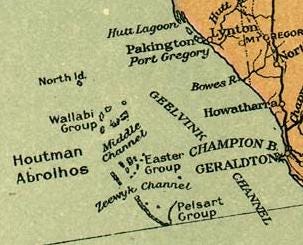
Two weeks ago, I attended a poetry night where I had the amazing opportunity to hear Jarad Bruinstroop, a Queensland poet, read aloud from his 2023 poetry collection, Reliefs. I purchased the book and stumbled across his poem, The Crew of the Zeewijk, 1727, inspired by the real-life marooning of two ship-boys accused of homosexual acts off the coast of Western Australia (as pictured in the map above). Their names were Adriaan Spoor and Pieter Engelse, and the event is referred to as the start of Australia’s European queer history.
I combined the final two lines of Bruinstroop’s poem with my own short story:
“Without food or water because they had sinned.
Separate islands in case they sinned again.”
It stuck with me that even though the boys had been condemned to a slow and painful death, the crew went the extra length to make sure they died alone out of fear that they would repeat their so-called “sinful” acts.
I wanted to develop a theme of hope and construe queer love as something beautiful that deserves to be celebrated. The protagonist, although given the same punishment and separated from her lover, is held superior to the close-minded crew because of the love she holds so dearly. Through describing her lover in terms of the environment, the protagonist immortalises her, letting her lover live on regardless of whether she’s able to successfully swim to the other island:
She is the warmth of the sun radiating upon me. She is the sting of salt against the minor cuts in my feet. She is the caress of wind wrapping around me. She is the sticky sand clinging to me.
The final line of my short story likewise immortalises the two ship-boys by naming them and enfolding their fates with her own. Although they died alone, the protagonist, like Bruinstroop, makes sure that their memories continue, retroactively absolving them.
J Bruinstroop, Reliefs, University of Queensland Press, St Lucia, 2023, p. 15.
This is just exquisite, now im going to deep dive find more.
Wow this is a wild topic and makes me want to read and research more! Thank you for keeping this alive!